With the February 8 general election just a little over a month away, the upper house of Parliament on Friday passed a resolution seeking to delay the polls due to security concerns.
The caretaker government and the PML-N opposed the resolution, which was moved by independent Senator Dilawar Khan.
As he read the resolution out loud, Dilawar said the Constitution upheld the right to vote for every citizen of Pakistan and the Election Commission of Pakistan was bound to conduct free and fair polls in contingent upon inclusivity and ensuring the participation of all regional people.
“The vote turnout in colder areas remains notably high during the moderate weather conditions. January and February are recognised as the coldest months in the majority of the areas in Balochistan and Khyber Pakhtunkhwa,” he said.
Dilawar noted that various political parties had expressed their reservations regarding difficulties in ensuring participation in cold areas during the electoral process.
He expressed “great concern” on the recent attempts on the lives of JUI-F chief Fazlur Rehman, former lawmaker Mohsin Dawar, and other political figures.
“The Ministry of Interior has conveyed serious threats to the lives of prominent politicians increasing the challenges faced by political parties in exercising their right to a free and fair election,” Dilawar said.
He further highlighted that there had been a spike in attacks on security forces and citizens, particularly in KP and Balochistan. “The intelligence agencies have warned of militant attacks threats on election rallies in both provinces.”
This is a developing story that is being updated as the situation evolves. Initial reports in the media can sometimes be inaccurate. We will strive to ensure timeliness and accuracy by relying on credible sources, such as concerned, qualified authorities and our staff reporters.
The Sindh High Court’s (SHC) election appellate tribunal on Friday accepted the appeals of PTI Vice-Chairman Shah Mahmood Qureshi, his son Zain and party provincial president Haleem Adil Sheikh against the rejection of their candidatures for the upcoming polls.
Qureshi and his son had contested the rejection of their nomination papers by the returning officers (ROs) from the NA-214 constituency (Tharparkar-I) while Sheikh had done the same for NA-238 (Karachi-East IV).
The development comes just a day after Sheikh was granted bail by Malir judicial magistrate Saima Katto in a case related to the May 9 violence. A day before that, he was indicted in a case linked to rioting at city courts in Karachi.
The appeal acceptance also follows that of PTI Central Vice President Firdous Shamim Naqvi, who had submitted his nomination papers from Karachi’s NA-236.
The RO had objected to Qureshi and Zain’s candidature for not providing details of their assets, source of income and paid taxes.
Meanwhile, Sheikh’s papers had been rejected for failing to “disclose details of clearance from the police/anti-corruption” and not providing the No Dues Certificate from the provincial assembly, as per the last hearing’s order.
The election tribunal had issued notices to the Election Commission of Pakistan (ECP) and others on the PTI leaders’ appeals on Wednesday.
The appeals had been filed through Advocate Ali Tahir, who appeared before the tribunal today and confirmed to Dawn.com that his clients were allowed to contest the polls.
Justice Adnanul Karim Memon presided over the hearing during which he heard the arguments of the parties concerned, including the ECP. He subsequently set aside the objections raised by the ROs, declaring them illegal, and directing the officials to accept the PTI leaders’ nomination papers.
Separately, the appellate tribunal also accepted the appeals of PTI candidate Arsalan Khalid and the PPP’s Mirza Ikhtiar Baig from NA-241 (Karachi South-III).
Notices issued on Fawad Chaudhry’s appeal
Meanwhile, the election appellate tribunal of Lahore High Court’s Rawalpindi bench issued notices on the appeals of former information minister Fawad Chaudhry and his wife, Hiba, against the rejection of their nomination papers from NA-61 (Jhelum-II).
Justice Chaudhry Abdul Aziz presided over the hearing today.
The tribunal sought details from the Federal Investigation Agency of Fawad’s and Hiba’s travels abroad as well as bank account details. Hearings on both appeals were adjourned till tomorrow.
Fawad had parted ways with the PTI soon after a countrywide crackdown on the party as initiated after the May 9 riots sparked by its chairman Imran Khan’s arrest.
Although the ex-minister had said at the time that he was “taking a break from politics”, he was seen at the launch ceremony of the Jahangir Khan Tareen-led Istehkam-i-Pakistan Party (IPP) in June.
However, Fawad has kept quiet on whether he is officially a part of the IPP, which has been joined by several PTI leaders in the aftermath of May 9.
Separately, a Rawalpindi election appellate tribunal headed by Justice Mirza Viqas Rauf accepted PTI leader Zulfi Bukhari’s appeal, allowing him to contest polls from Attock.
His candidature from NA-50 (Attock-II) had been rejected.
Aneesa Bibi*, 67, cooks food at two homes to make a living. She lives with her husband in a rented two-bedroom house located on the first floor in a middle-class neighbourhood in Karachi.
At the entrance is a small kitchen, which leads to a large room with two single beds. The other room is smaller and has a few plastic chairs, a drying stand, a trunk, and a few other things. Bibi’s only child, Raheel, lives on the ground floor of the same house with his wife and two children.
Bibi was diagnosed with a cardiovascular disease (CVD) since the past two years, when she started experiencing severe chest pain. At the time, her son took her to the Jinnah Postgraduate Medical Centre (JPMC) — the city’s largest public sector hospital — after the doctor at a local clinic, and two private hospitals refused to treat her. Subsequently, one of her heart valves was replaced in a successful surgery at the hospital.
Following her surgery, the doctors instructed her to have two proper meals a day. While Bibi enjoys cooking, she has largely been unable to follow the doctor’s instructions. Financial constraints and responsibilities limit her food intake to only one meal a day. She does, however, try to cook food with less salt and oil due to her health. “I knew beforehand that salty and oily food is unhealthy. Why should I become an enemy of my own health when I have to do everything myself?” she questioned rhetorically.
The price of poverty
Bibi earns Rs14,000 per month which is barely enough to cover household expenses. She leaves for work at 6am and after cooking at the two homes, she comes home late in the evening.
A lack of family support from her son has added to Bibi’s woes as cooking at home has become a tiresome activity on top of a full work day. “Sometimes, I am so tired that I don’t cook food at all and sleep without eating anything. This happens at least thrice a week.”
Bibi and her husband are not able to eat the recommended amount or quality of food every day. For breakfast, they have one sugar-free rusk with a cup of tea. Then they have dinner. At work, Bibi’s employers sometimes ask her to have lunch or cook food for herself but “the pressure of work is so intense that it has robbed me of my appetite”, she lamented.
Over time, inadequate food intake has created multiple issues for Bibi. She feels dizzy, has trouble sleeping at night as well as waking up in the morning. A few months ago, she had a bad fall, breaking two of her teeth. Despite this poverty-induced hunger, Bibi thanks God for whatever food is available to her.
Of late, the one-time meal she shares with her husband has also become increasingly difficult to afford. She usually cooks mixed sabzi (vegetables) since it is easier to cook. Meat remains a luxury. “The doctor has advised me to have meat once a week, however, I rarely cook it once a month.”
At the same time, the responsibility of earning forces Bibi to work despite her age, stamina and will.
Gendered diets
According to the World Health Organisation (WHO), cardiovascular diseases are the leading cause of death globally, claiming an estimated 17.9 million lives each year. CVDs are a group of disorders of the heart and blood vessels and include coronary heart disease, cerebrovascular disease and rheumatic heart disease, among other conditions. The most important behavioural risk factors of heart disease and stroke are unhealthy diet, physical inactivity, smoking and harmful use of alcohol.
CVD is the leading cause of death in Pakistan. In 2019, 32.84 per cent of deaths in the country were attributed to some form of CVD.
A recent study on the motivators and deterrents to diet change in low socio-economic Pakistani patients with CVD found that structural support, particularly for women, is a major issue.
Dr Rubina Barolia — associate professor at the School of Nursing and Midwifery at the Aga Khan University (AKU) and the lead researcher of the study — stated that structural factors often force female CVD patients to compromise on their own health to accommodate male family members. “In our culture, it is common for men to eat first as quality food is often reserved for them, while women have their meals from whatever is left over,” she said.
Another issue the researchers found in low-income households was that since one meal is cooked for the entire family, the female patients could not make separate meals with less oil and salt. Dr Barolia suggested that the food can be adjusted for the whole family to make it healthier, however, the perception of ‘mareezoon wala khana’ (bland food meant for patients) is a big hindrance.
Professor Khawar Abbas Kazmi is the head of Preventive Cardiology at the National Institute of Cardiovascular Diseases (NICVD), Karachi and a visiting faculty member at AKU. In his opinion, family members, as well as the patients themselves have a perception of ‘bland food’ — or any food with special instructions/accommodations — being unmanageable or unsustainable in the long run. This mindset bars them from following doctors’ recommendations.
He differentiated between chronic and acute illnesses, emphasising the differences in diets between the two. A “bland or liquid diet” is usually recommended temporarily to patients with acute illnesses. However, CVD is a chronic illness that lasts a lifetime and requires lifestyle changes.
Everyday meal choices for most Pakistanis are usually unhealthy, containing high amounts of fats and high carbohydrates, making it a major cause of heart disease. When a person is diagnosed with a heart condition, families usually opt to make separate meals for the patient. However, this is only followed for a very limited amount of time since it is a laborious task.
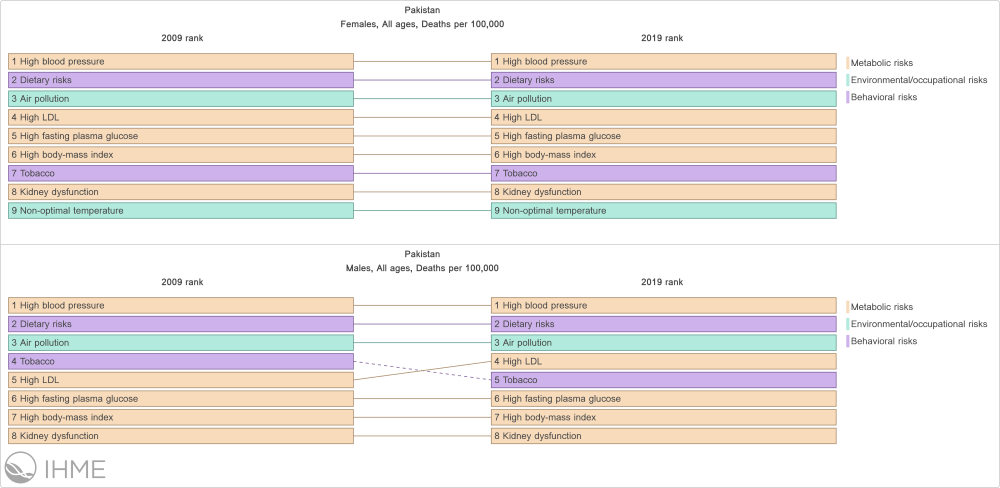
Dietary risks are the second leading cause of death among CVD patients in Pakistan after high blood pressure. CVD patients from lower socio-economic classes usually consider following a healthy diet plan as an unaffordable option as their families are unaware of alternatives.
Risk factors of death among CVD patients in Pakistan categorised by sex. Source: Institute For Health Metrics and Evaluation (IHME)
Sidra Raza is the head of Nutrition and Food Services at the NICVD. She gives her patients two options to resolve the hassle of cooking separate food.
“My first priority is to make patients understand that children develop eating habits at an early age and healthy food choices, with low oil and fat, develop their taste buds accordingly. If they are made to follow a healthy diet since childhood, they most likely won’t face diet-induced heart issues for the rest of their lives. In this case, one healthy meal is cooked for the entire family,” explained Raza.
However, if the first piece of advice doesn’t work, she advises patients to separate their meals before adding oil or salt to it. “It makes a healthy diet for the patient and other family members can eat the usual food.”
The choice between food and medicine
The cost of medicines for CVD patients becomes difficult to manage in a household that is already struggling with basic food expenses. Aneesa Bibi’s medicines for her heart condition and diabetes cost Rs300 a day. She cannot afford to take her medicines daily.
“The basic medicines for a cardiovascular patient cost more than a food basket, which means that one family member has to starve so that the patient can afford to have their medicines on a regular basis,” said Dr Kazmi.
“A lot of (low-income) patients are not sure whether they can afford two-time meals. How can I tell them to have five portions of vegetables and fruits per day?”
For her part, Raza says she performs a detailed assessment of patients’ financial backgrounds before advising them on their food choices. She believes that a healthy and nutritious diet does not mean it has to be expensive. “Even within financial constraints, patients can equally enjoy a well-balanced nutritious diet,” she said.
The dietician shares food combinations that provide a good source of nutrition and are easy to manage. “Beans and mixed lentils are excellent sources of protein. A few drops of lemon juice and a little spinach in mixed lentils make it a protein and iron-rich food that is affordable.”
She also gave the example of seasonal fruits like grapes: “Seasonal fruits are always cheap and they are not required in a huge quantity. Only a handful of grapes (17 to be exact) are enough for one day’s portion size.”
Family support
In her study, Dr Barolia found that children were usually more supportive of their mothers than husbands of their wives with CVD. Children often joined their mothers in having doctor-advised healthier food. However, the mothers also felt guilty that their illness made their children sacrifice their food choices.
Family support for female patients in having healthy food is reflective of society’s gender inequality at large. Dr Kazmi elaborated: “A male patient’s meal becomes a priority and all members of the family are ready to have the same food. However, the same is not true for women with illnesses and special dietary requirements.”
Dr Kazmi held medical personnel responsible for the lack of proper guidance on diet. “Ninety-nine per cent of the time, the patients are given flimsy information about their diet. They are provided with a paper that has information on food choices but are not properly advised on how to go about their diet”.
Furthermore, Dr Barolia also found that food only serves to satisfy hunger for some patients and with the burden of other responsibilities, food and nutrition requirements take a back seat. A research participant stated: “I have to manage the weddings of two of my daughters. How can I think of food choices in this situation?”
Patriarchy and women’s health
Sheema Kermani, a social activist who works for women’s rights, was of the opinion that “the whole issue of women’s health is totally and inevitably related to the issue of women’s status in society”.
“In a highly patriarchal society, women and women’s lives are of little value. Families prioritise their sons’ education over their daughters’. In the context of many rural areas, women’s lives become even more dispensable. A cow is more valuable than a woman. A woman can be easily replaced. A cow costs much more,” said Kirmani.
“Girls are looked upon as a burden — men consider that their family’s honour is vested in girls keeping their virginity intact. Girls also have to be ‘married off’. This becomes a financial, social and moral responsibility.”
“Given this situation, it is no wonder that girls from lower socio-economic households are not fed healthy foods from an early age. They grow up malnourished and are married off while they are still children. Their bodies are underdeveloped, and they are unable to bear healthy children.”
For Kermani, it is no surprise that when a woman has a health problem, the family is not willing to spend money on her.
The PTI on Thursday approached the Supreme Court (SC) against the Peshawar High Court’s (PHC) decision to restore an Election Commission of Pakistan (ECP) ruling revoking the party’s ‘bat’ electoral symbol over discrepancies in holding intra-party elections.
The petition has been fixed for hearing for tomorrow (Friday).
On December 22, the ECP had stripped the party of its electoral symbol for the February 8 election, saying that it had had failed to hold intra-party polls — which saw Barrister Gohar Khan becoming the PTI chairman — in accordance with its prevailing constitution and election laws.
The PTI had approached the PHC against the decision of the ECP and on Dec 26, a single-member bench of the high court ordered a temporary suspension of the ECP’s decision, instructing the commission to publish PTI’s intra-party poll certificate on its website and restore the party’s election symbol ‘bat’. That order had to remain in effect till Jan 9.
Subsequently, the ECP had filed an intra-court appeal in the PHC against the verdict. The commission’s lawyers argued that the court had overstepped its jurisdiction by suspending the commission’s declaration on PTI’s intra-party polls and the subsequent revocation of its election symbol.
A day earlier, the PHC had accepted the commission’s review plea and decided that the high court’s interim order on Dec 26 was an “ex parte order” as the same was passed without providing any opportunity for a hearing to the commission.
“Under the election laws the whole exercise of holding and conducting an election i.e. right from the issuance of notification of holding an election till the publication of names of the successful; candidates in the official gazette, is a time-bound exercise, therefore, the said order has prima facie created hindrance in the smooth process of the election which is to be conducted by the ECP […] on the instant 8th of February,” the order said.
“In view of the above, the interim order of this court passed in favour of the writ petitioner/ PTI is hereby recalled/vacated and consequently the ECP is directed to proceed with the election process as per its constitutional mandate as well as various orders of the Supreme Court of Pakistan passed in respect of the ensuing election and it shall ensure to conduct and hold free, fair and transparent election,” it added.
The court further pronounced that the grievance of the petitioner as agitated in the main writ petition was to be considered and finally adjudicated upon by this court on the date fixed (Jan 9). It ruled that the said interim order, prima facie, amounted to the grant of final relief for all the legal, factual and practical purposes.
“While passing the said order, an aspect of its effectiveness beyond the territorial jurisdiction of this court was not taken into consideration,” the order said.
The petition filed by the PTI in the top court today, copy of which is available with Dawn.com, named the Election Commission of Pakistan (ECP), PTI founding member Akbar S. Babar and 13 others, who had approached the electoral watchdog against the party’s intra-party polls, as respondents.
The plea argued that the interim relief originally granted by the PHC was given after hearing the ECP, which was reflected in the court’s Dec 26 order, therefore yesterday’s PHC verdict was “not sustainable”.
The plea said that there were 227 reserved seats and without the interim relief order, nomination forms could not have been filed by the candidates contesting for these seats. It further argued that the relief granted by the PHC was not “final” and the order was only operative till Jan 9. It said that the court had not disposed of the entire matter, terming yesterday’s verdict “misconceived”.
It contended that the high court’s jurisdiction extended to examining the validity of the orders passed by the ECP. “If territorial effectiveness or an order of the High Court is to be seen as observed by the learned single judge, then in every case one will have to [approach] all five high court and [have] all high courts to pass the same order for it be implemented all over Pakistan,” it said.
It said that the ECP did not have the jurisdiction to challenge the “internal appointments” of PTI officials or set aside the party’s intra-party elections and declare them void. The petition said the ECP was not a “court of law”, reiterating that it could not question the appointments made by a political party or examine the validity of intra-party polls.
The petition said that “perusal of Election Act 2017 showed that political parties are fully empowered to run their affairs and no role of interference of ECP has been envisaged in these provisions at all”.
“That it is vehemently submitted that PTI has been discriminated against all other political parties who follow less onerous political processes of holding intra-party elections in accordance with their own constitutions,” it said.
The plea further contended that by denying the PTI its election symbol, the election commission had made the party “dysfunctional and has violated Article 17 of the Constitution”.
It said that the right to contest an election under a common symbol could not be taken away, even by the ECP. The petition termed the PHC’s Wednesday order as “too harsh, irrational and unreasonable to be sustained”.
“It is therefore most respectfully prayed that this court may kindly be pleased to grant leave to appeal against the impugned order, set the same aside and restore the interim relief in the interest of justice,” it added.
PTI will contest poll, asserts Khosa
Speaking to the media in Rawalpindi, PTI leader said that the electoral watchdog had become a “facilitator” of sorts, due to which the PHC’s interim relief was revoked.
He said that such tactics demonstrated that the party’s political opponents were not prepared to face it in the electoral battlefield and were engaging in conspiracies.
“Whether we get the ‘bat’ symbol or not, the PTI as a party will contest [the polls] and it will do so on one symbol,” he said. Khosa said that PTI founder Imran Khan was bent on “serving the nation” and giving them their rights once he was released from jail.
The Islamabad High Court (IHC) on Thursday restored 10-year disqualification for convicts charged under the National Accountability Ordinance (NAO) and suspended its earlier ruling limiting the same to five years.
The decision was taken by an IHC division bench comprising Justice Mohsin Akhtar Kiyani and Justice Saman Rifat Imtiaz on an appeal filed by the National Accountability Bureau (NAB) against the disqualification of former Balochistan minister Mir Faiq Jamali.
The accountability watchdog had on July 25 challenged the IHC single-bench order limiting the disqualification to five years, since the National Accountability Ordinance (NAO) provides for 10-year disqualification for a convict.
An accountability court had sentenced Jamali to a 14-year imprisonment with a fine of Rs6 million over corruption charges. He was released from prison after completing his jail term in October 2013.
In July 2019, a three-member bench of the Supreme Court, headed by the then-chief justice of Pakistan (CJP) Asif Saeed Khosa and comprising Justice Gulzar Ahmed and Justice Sheikh Azmat Saeed, barred Jamali from contesting elections till 2026.
The case was filed by the former minister to seek clearance to contest the elections.
The Pakistan Electronic Media Regulatory Authority (Pemra) on Thursday informed the Lahore High Court (LHC) that there was no ban on broadcasting former prime minister Imran Khan’s speeches.
The revelation was made by Pemra counsel Haroon Duggal during the hearing of a petition filed by Imran — who is currently incarcerated at Adiala Jail — last year against the authority’s decision to bar all satellite TV channels from broadcasting his speeches and press talks.
The ban was imposed with “immediate effect” after Imran had lashed out at former army chief Qamar Javed Bajwa for what he called “protecting incumbent rulers in their alleged corruption cases”.
The PTI chief had subsequently approached the court and challenged the ban, arguing that Pemra’s order was “purely driven out of vengeance”. The LHC has so far conducted eight hearings on the case since its initiation, Imran’s lawyer Ahmed Pansota told Dawn.com.
Today, Imran’s legal counsel, Pansota, and the federal government’s lawyer appeared in court. LHC’s Justice Shams Mehmood Mirza presided over the proceedings.
During the hearing, the court emphasised that Pemra should refrain from exerting pressure on TV channels regarding the concerns raised by the petitioner.
In response, Pemra counsel Mir said there was no ban on telecasting speeches of the petitioner.
Following the brief arguments, the court wrapped up the petition.
Imran vs Pemra
In the prohibition order issued last year, Pemra had referred to previous directives wherein all licensees were directed to “refrain from telecasting any content against state institutions”.
The authority had noted that Imran, in his speeches and statements, was “levelling baseless allegations and spreading hate speech through his provocative statements against state institutions and officers which are prejudicial to the maintenance of law and order and is likely to disturb public peace and tranquillity.”
Pemra had said that licensees telecasted the content without the effective utilisation of the time delay mechanism, in violation of the authority’s laws and judgements by the apex court.
“… therefore, the competent authority i.e. chairman Pemra in view of the above mentioned background and reasons, in the exercise of delegated powers of the authority vested in Section 27(a) of the Pemra Ordinance 2002 as amended by Pemra (Amendment) Act 2007, hereby prohibits broadcast/rebroadcast of speech(s)/press talks (recorded or live) of Imran Khan on all satellite TV channels with immediate effect,” the order had said.
The authority had also directed all satellite TV channels to ensure that an “impartial editorial board” is constituted to ensure that their platforms is not used by anyone for “uttering remarks in any manner which are contemptuous and against any state institution and hateful, prejudicial to law and order situation in the country”.
Challenging the Pemra order, Imran had pointed out that the IHC had set aside a similar prohibition order in the past.
The petition had said that Pemra issued the order “in excess of the jurisdiction vested in it and without having regard to the constitutional rights guaranteed under Articles 19 and 19-A of the Constitution”. It had further contended that the authority was not empowered to issue a blanket prohibition order, which appears to be “in violation of the principle of proportionality”.
The plea had argued that according to Section 8 of the Pemra Ordinance, one-third of the total number of members were required to constitute quorum for meetings. But the meeting which passed the order against Imran comprised only the chairman and three members which made the order “coram-non-judice”.
It had contended that Pemra’s order was “illegal, unlawful, more than its jurisdiction, and contrary to the fundamental rights as enshrined under the Constitution” and liable to be set aside.
Japanese rescuers scrambled to search for survivors on Wednesday as authorities warned of landslides from heavy rain after a powerful earthquake that killed at least 62 people.
The 7.5-magnitude quake on January 1 that rattled Ishikawa prefecture on the main island of Honshu triggered tsunami waves more than a metre high, sparked a major fire and tore apart roads.
The Noto Peninsula on the Sea of Japan coast was most severely hit, with buildings ravaged by fire and houses flattened in several towns, including Wajima and Suzu, as shown by before-and-after satellite images.
The regional government announced on Wednesday that 62 people had been confirmed dead and more than 300 injured, 20 of them seriously.
The toll was expected to climb as rescuers battle aftershocks and poor weather to comb through rubble.
More than 31,800 people were in shelters, and at least 200 buildings had collapsed, with the number expected to rise, the government said.
“More than 40 hours have passed since the disaster. We have received a lot of information about people in need of rescue and there are people waiting for help,” Prime Minister Fumio Kishida said on Wednesday after an emergency task force meeting.
The number of military personnel sent to the area on rescue missions has been doubled, with more rescue dogs also deployed, he added.
The operation was given extra urgency as the Japan Meteorological Agency (JMA) issued a heavy rain warning in the region, advising people to be on alert for landslides until Wednesday evening.
There were “almost no houses standing” in one town in the Suzu area, said municipal mayor Masuhiro Izumiya.
“About 90 per cent of the houses (in that town) are completely or almost completely destroyed […] the situation is really catastrophic,” he said, according to broadcaster TBS.
Around 32,800 households were still without power in Ishikawa prefecture, the local utility said. Many cities were without running water.
Plenty of food and emergency supplies have arrived in the region, but blocked or damaged roads have slowed their delivery to communities, regional authorities said.
Yuko Okuda, 30, was taking shelter at an evacuation centre at the municipal office of the town of Anamizu, down the coast from Suzu.
“I’m here because our lifelines have been cut off. Electricity, water and gas — everything. And as aftershocks keep happening, our house could collapse at any time,” she told AFP.
“The cold and the lack of food are my biggest concerns now,” she said, explaining that her son is allergic to eggs and so could not eat the food provided.
Trains, highways reopened
Shinkansen bullet trains and highways have resumed operations after several thousand people were stranded — some for almost 24 hours.
The US Geological Survey said the quake had a magnitude of 7.5, while the JMA measured it at 7.6, triggering a major tsunami warning.
The powerful quake was one of more than 400 to shake the region through Wednesday morning, the JMA said.
After the main jolt, waves at least 1.2 metres (four feet) high hit Wajima and a series of smaller tsunamis were reported elsewhere.
Japan experiences hundreds of earthquakes every year and the vast majority cause no damage, with strict building codes in place for more than four decades.
Earthquakes have hit the Noto region with intensifying strength and frequency over the past five years.
The high number of aftershocks is a result of the “complex” fault systems below the peninsula, Yoshihiro Ito from Kyoto University’s Disaster Prevention Research Institute told AFP.
The country is haunted by a massive 9.0-magnitude undersea quake off northeastern Japan in 2011, which triggered a tsunami that left around 18,500 people dead or missing.
It also swamped the Fukushima atomic plant, causing one of the world’s worst nuclear disasters.
Minor damage was reported at some nuclear power plants along the Sea of Japan shoreline after Monday’s earthquake and aftershocks — including leaks of water used to cool nuclear fuel and a partial shutdown of power at one plant.
The plant operators said there was no danger of damage to the environment or the nuclear power stations themselves.