North Korean leader Kim Jong Un wrapped up the year with fresh threats of a nuclear attack on Seoul and orders for a military arsenal build-up to prepare for a war that can “break out any time” on the peninsula, state media reported on Sunday.
Kim lambasted the United States during a lengthy speech at the end of five days of year-end party meetings that set his country’s military, political and economic policy decisions for 2024.
The meeting announced plans for further military development in the coming year, including launching three more spy satellites, building unmanned drones and developing electronic warfare capabilities, as well as strengthening nuclear and missile forces, according to the official Korean Central News Agency (KCNA).
This year, Pyongyang successfully launched a reconnaissance satellite, enshrined its status as a nuclear power in its constitution and test-fired the most advanced intercontinental ballistic missile (ICBM) in its arsenal.
Kim accused the United States of posing “various forms of military threat” and ordered his armed forces to maintain the “overwhelming war response capability”, according to KCNA’s account of the meeting that ended on Saturday.
The meeting concluded that it is a “fait accompli that a war may break out on the Korean peninsula any time due to the enemies’ reckless moves for invading the DPRK”, KCNA said, using the acronym of the North’s official name.
In an effort to deter Pyongyang, Washington deployed a nuclear-powered submarine in the South Korean port city of Busan this month and flew its long-range bombers in drills with Seoul and Tokyo.
The North has described the deployment of Washington’s strategic weapons, such as B-52 bombers, in joint drills on the Korean peninsula as “intentional nuclear war provocative moves”.
The military “should rapidly respond to any possible nuclear crisis and put continuous spurs to the preparations for a great event to suppress the whole territory of south Korea by mobilising all physical means and forces including nuclear forces in contingency”, Kim said.
‘Uncontrollable crisis’
Kim told the meeting he would no longer seek reconciliation and reunification with South Korea, noting the “uncontrollable crisis” that he said was triggered by Seoul and Washington.
Inter-Korean relations have deteriorated to a low point this year, with Pyongyang’s spy satellite launch prompting Seoul to partially suspend a 2018 military agreement aimed at defusing tensions.
Kim said it would be a mistake to regard South Korea “who publicly defined us as the ‘principal enemy’ […] as the partner of reconciliation and reunification”, according to KCNA.
Kim also ordered the drawing-up of measures for reorganising departments handling cross-border affairs to “fundamentally change the principle”.
Leif Easley, a professor of international relations at Ewha University in Seoul, said the emphasis on North Korea’s “significant military capabilities” was likely aimed at hiding its poor economic achievements this year.
“Much of what state-controlled media publishes is recycled propaganda,” he said, adding “Pyongyang’s bellicose rhetoric suggests its military moves are not only about deterrence but also domestic politics and international coercion.”
Pyongyang declared itself an “irreversible” nuclear power in 2022 and has repeatedly said it will never give up its nuclear weapons programme, which the regime views as essential for its survival.
The United Nations Security Council has adopted many resolutions calling on North Korea to halt its nuclear and ballistic missile programmes since Pyongyang first conducted a nuclear test in 2006.
The year 2023, on the news front, was dominated by former prime minister Imran Khan, his arrest, the subsequent events of May 9, and the consequent crackdown on the PTI that led to a switching of political loyalties.
Throughout these events, one question persisted on the media’s minds: will the elections take place? When will they be held?
But surprisingly, only a few of these events garnered the attention of Dawn.com’s avid readers.
Instead, it was topics like the Khalistan Movement, the IMF-dictated bill being passed by the National Assembly, an opinion piece on the criticism of the country’s elite class, a take on the Pak-India World Cup fixture, and PIA flight attendants slipping away in Canada that captivated the interest of readers in 2023.
Scroll down to find out more about the 10 stories published on Dawn.com that attracted the highest digital traffic in the outgoing year.
10. Two more PIA flight attendants vanish in Canada
Published November 14
Over the past three years, it has almost become a trend for Pakistan International Airlines (PIA) flight attendants to slip away, particularly in Canada.
Last month’s escape brought the total number of PIA crew members who have successfully slipped away upon arrival in Toronto to four this year. But what’s alarming is the fact that four PIA crew members slunk away last year too.
A still image of a PIA plane. — File
And a year prior in 2021 as well. The incident even prompted PIA to confiscate the passports of cabin crew on arrival in a bid to control the incidents but to no avail as aforementioned.
In the latest incident, two senior flight attendants, Khalid Mehmood and Feda Hussain, reached Canada from Islamabad by PIA flight PK772 and slipped away.
Finding this on the list pointed out that the article did end up answering the question asked in the headline succinctly.
It discussed the multifaceted interactions between Islam and the South Asian region during the golden age of Islam apart from talking about the Indus Valley’s role in enriching the Muslim world with scholars.
Illustration. — Sheece Khan
The article challenges the stereotypical narrative that portrays Islam’s advent into South Asia as one-sided, asserting that the exchange of knowledge and cultural influences was reciprocal.
Take a delve into history by reading more about it here
8. If Pakistan defaulted…
Published on February 6
The “what if” question and the potential repercussions also captivated our readers considering the economy’s troubled state with sky-rocketing inflation and a stalled at the time International Monetary Fund (IMF) programme.
The IMF executive board approved the much-needed nine-month standby arrangement (SBA) with Pakistan in June “to support its economic stabilisation programme”.
In the latest developments, the Fund reached a staff-level agreement with Pakistan on the first review of a $3 billion bailout where the country will receive $700 million after approval.
This article by an Islamabad economist namely Asad Ejaz Butt shed light on the consequences Pakistan had to face if it defaulted with the IMF.
Former prime minister Imran Khan’s first arrest on May 9, from the premises of the Islamabad High Court can be termed, one of the biggest political events of 2023.
The details about the Al Qadir Trust case in which the PTI Supremo was arrested for the first time resonated profoundly with Dawn.com readers.
Shehzad Akbar, Imran Khan and Malik Riaz. — File
He was later released by the Supreme Court but the events that took place between Imran’s arrest and release will haunt the officious corridors of power and also PTI for a long time.
After three months, the star cricketer-turned-politician was nabbed again after a lower court found him guilty of “corrupt practices” in the Toshakhana case and sentenced him to three years in prison.
Details surrounding the Al Qadir Trust case can be read here
6. Why the TTP is undefeatable?
Published on Jan 7
Pakistan has witnessed an uptick in terror activities in recent months, especially in Khyber Pakhtunkhwa and Balochistan, after the banned militant Tehreek-i-Taliban Pakistan (TTP) ended its ceasefire with the government last year.
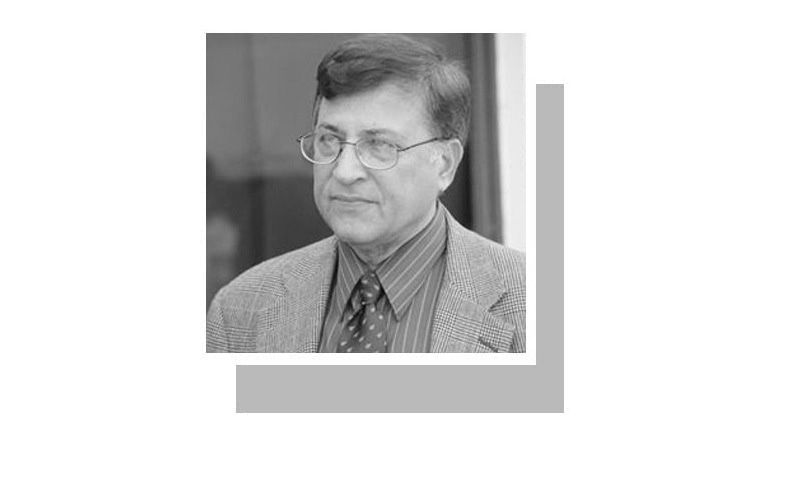
Pervez Hoodbhoy. — File
The question posed in the article engaged our readers through the insights of Islamabad-based physicist and writer Pervez Hoodbhoy.
He talks about how the Pakistan Army “with its tough professionalism and experience in non-conventional warfare could have conclusively defeated a ragtag terrorist militia” but that did not happen.
Read more about the tactical and strategic missteps that strengthened the enemy here
5. Cartoon
Published on Nov 16
The cartoon by Muhammad Zahoor published in Dawn newspaper secured the fifth spot in terms of digital traffic.
It depicted PML-N Supremo Nawaz Sharif standing in the middle of a herd of sheep with a signboard labelled “Balochistan”.
This cartoon was published a day after Sharif’s first visit to Balochistan following his return. He managed to rope in over two dozen electables from the country’s largest province ahead of the forthcoming general elections on Feb 8.
4. Pakistan take on India in World Cup as clear underdogs
Published on October 13
Taha Anis’ take on the year’s most anticipated cricket fixture, detailing how the home team stood little chance against their arch-rivals, also captured the attention of Dawn.com readers.
Pakistan huddle during practice at the Narendra Modi Stadium, Ahmedabad on October 12. — Reuters
The prediction turned out to be correct as India steamrolled Pakistan by seven wickets in a lopsided blockbuster match.
Pakistan were bowled out for 191 in the 43rd over after their batting line-up collapsed characteristically in the face of disciplined Indian bowlers.
Writer and physicist Hoodbhoy takes another spot on the list with his opinion piece discussing elite bashing, which he terms the “newest sport” initiated by the country’s masses.
He beams a spotlight on the comparison between the Pakistan and world’s elite class, highlighting that the Pakistani elite also “spits on the law just like the common man”.
2. NA passes IMF-dictated finance supplementary bill
Published on Feb 21
The government’s imposition of an additional Rs170 billion in taxes, at the insistence of the IMF, took the country’s middle class by storm.
The then Finance Minister Ishaq Dar speaks in the National Assembly session. — DawnNewsTV
Despite clearly lacking quorum, the National Assembly (NA) passed the bill with the then finance minister Ishaq Dar pinning the blame on PTI for being solely responsible for this economic burden on the masses.
Read more on the lackluster debate here as NA passed the bill
1. What is the Khalistan movement and why is it fuelling India-Canada rift?
Published on September 19
Tensions between Canada and India escalated when the Canadian government expelled an Indian diplomat who was “the chief of India’s intelligence agency” in the country over the murder of a Sikh leader in British Colombia.
Sikh separatists demand that their homeland “Khalistan”, meaning “the land of the pure”, be created out of Punjab.
Representative image. — WION
The demand has resurfaced many times, most prominently during an insurgency in the 1970s and 1980s that paralysed the Indian Punjab for over a decade.
Read up more on the Khalistan Movement which is considered a security threat by the Indian government
Our top 11-15
The next five most-read pieces of 2023 (numbers 11-15) are:
Russia launched fresh strikes against Ukraine at dawn on Sunday, a day after vowing to retaliate for what it called a “terrorist attack” on the city of Belgorod.
Several Iranian-made “Shahed” drones targeted Ukraine’s northeastern city of Kharkiv overnight, according to local authorities, as the two sides have taken turns accusing each other of pummelling civilian areas of their shared frontier over the weekend.
“As a result of the night attack of Russian drones on Kharkiv, buildings in the city centre were damaged. These are not military facilities, but cafes, residential buildings and offices,” the city’s mayor, Ihor Terekhov, wrote on Telegram, without mentioning casualties.
“On the eve of the New Year, Russians want to intimidate our city, but we are not scared.”
The strike follows the deadliest attack on civilians in Russia since the start of the conflict in February 2022.
At least 22 people were killed and dozens more wounded on Saturday in Belgorod, a Russian city just 30 kilometres (19 miles) from the border that has been repeatedly struck by what Moscow says is indiscriminate shelling.
Moscow said Saturday’s attack included the use of controversial cluster munitions, and told an emergency meeting at the UN Security Council that Kyiv had targeted a sports centre, an ice rink and a university.
Russian envoy Vasily Nebenzya called it a “deliberate, indiscriminate attack against a civilian target”.
Ukraine’s allies countered that responsibility ultimately lay with Russian President Vladimir Putin for invading the neighbouring country two years ago.
“If Russia wants someone to blame for the deaths of Russians in this war, it should start with President Putin,” said British envoy to the UN Thomas Phipps.
Both Putin and Ukraine’s President Volodymyr Zelensky are due to give New Year’s Eve speeches on Sunday, as the conflict between their countries approaches its second anniversary in February.
January 1, day of mourning
In Belgorod, footage posted online showed a street strewn with debris and smoke billowing from burned-out cars in the city’s centre. AFP was not able to immediately verify the circumstances of the strike.
Authorities in Belgorod said the 22 dead included at least three children, with 109 people wounded.
The attack came a day after Ukraine said a barrage of Russian missile strikes on several cities, including the capital, had killed at least 40 people.
Schools, a maternity hospital, shopping arcades and blocks of flats were among the buildings hit in Friday’s barrage, one of the most violent attacks since the start of the war.
Ukraine was still sifting through the rubble on Saturday when fresh strikes hit the regions of Kherson, Zaporizhzhia and Chernigiv, according to local authorities.
Three more people were killed by Russian strikes across Ukraine on Saturday, the officials said.
The prosecutor’s office said Russian rocket attacks on Kharkiv on Saturday evening had wounded 26 people after hitting a range of buildings, including a hotel, a kindergarten, shops and restaurants.
The casualties included a British national, initially identified as a journalist, who was in fact a security adviser to a German media team, the statement added.
January 1 will be declared a day of mourning in the capital Kyiv, where at least 17 people were killed, city officials said.
Russia’s army said it had “carried out 50 group strikes and one massive strike” on military facilities in Ukraine over the past week, adding that “all targets were hit”.
The United Nations condemned the attacks and said they must stop “immediately”.
Appeal to Western allies
In the face of sustained Russian assaults, Ukraine is urging Western allies to maintain military support.
“Next year will be a time of many decisions — global decisions. And Ukraine needs to be able to influence them to be able to achieve its goals,” Zelensky said in his evening address on Saturday.
“We will fight for our influence, for justice for Ukraine, and I am grateful to all the leaders who help, who have been with us since February 24th and will be with us in 2024.”
Britain announced it would send hundreds more air-defence missiles to Kyiv, after Prime Minister Rishi Sunak declared: “We must continue to stand with Ukraine — for as long as it takes. “
Veteran politician and senior lawyer Aitzaz Ahsan has predicted that PML-N supremo Nawaz Sharif would leave the country before elections and watch the results unfold from there.
“He lives abroad anyway,” said Ahsan in an interview on DawnNewsTV programme “Doosra Rukh” on Friday night.
In the interview, the PPP stalwart also claimed that JUI-F leader Maulana Fazlur Rehman was “retreating [from elections]”, claiming that from the two drums that are beaten — either of victory or retreat — Rehman seemed to be “beating the drum of a retreat”.
Previously, the lawyer had also called Sharif a “ladla”(favoured) and had claimed that the Election Commission of Pakistan (ECP) and the caretaker government were trying to ensure Nawaz Sharif wins a two-thirds majority in next year’s general elections.
Nawaz, who had returned to Pakistan on October 21 after spending four years in self-imposed exile, said he had “no wish for revenge” and stressed on beginning a “new journey” towards growth.
‘Bat symbol’
As far as the PTI’s on-going tussle with the election commission goes, Ahsan said it would be unwise for the election watchdog to pursue this matter any further.
The ECP and the PTI have been exchanging blows over the past few days. The controversy stems from the electoral watchdog’s earlier decision to strip PTI of its symbol following the annulment of its intra-party elections for not complying with the Elections Act and the party’s own constitution.
PTI’s new chairman, Gohar Khan, had also claimed there was a conspiracy brewing against the party to snatch its electoral symbol ‘bat’ and exclude it from the upcoming elections.
“Is the election commission conducting elections or contesting them?” Ahsan asked, adding that the Ccommission cannot — and should not — go to high court regarding the bat symbol against PTI as it will show its bias against the party.
The lawyer was referring to the ECP’s decision to challenge the Peshawar High Court’s (PHC) order reinstating the PTI’s election symbol. Sources familiar with the matter told Dawn the ECP initially considered appealing directly to the Supreme Court but ultimately opted for a review petition with the PHC, which is scheduled to revisit the case on Jan 9. The ECP is also on notice to appear before the bench on the date.
The commission has yet to adhere to the PHC’s specific directives, including publishing PTI’s intra-party elections certificate on the ECP’s official website and reinstating the party’s election symbol.
Ahsan further added that disputing a judgment would create a chain, “If the High Court reverses the decision of the District Court, should the District Judge go to the Supreme Court to ask why the High Court has given a decision against his decision?”
Despite having little in common, even our political parties could agree on one thing: Pakistan’s economic situation was dire in 2023. The year saw Pakistan go through a long and rocky road to finding some semblance of economic stability — if it can even be called that — while weathering political and social turmoil. Pakistanis also experienced a double whammy this year: the one-two punches of the worst economic crisis in decades and all-time high inflation. Add to that the gut punch of the aftermath of the catastrophic floods of 2022 began to settle in.
Flood victims receive boiled rice from relief workers, after taking refuge on a motorway, following rains and floods during the monsoon season in Charsadda, Pakistan on August 27, 2022 — Reuters
In 2023, according to the World Bank, over 39.4 per cent of the population fell below the poverty line, which means over 12.5 million people are living in meagre conditions. Additionally, 8.5 million people face acute food insecurity due to high inflation and the balance of payments crisis, effectively making the country one of the worst in terms of food security on the Global Hunger Index.
Those who could leave just up and left the country. Several of my close friends moved abroad too because of the uncertainty. They were not alone. More than 450,000 people left Pakistan in the first three months of 2023 because of a lack of employment opportunities and the consensus that Pakistan was on the brink of default.
A default, according to Faisal Mamsa, the chief executive of Tresmark, is the culmination of a series of events. The primary cause is that outflows of cash are consistently more than inflows, and you need to borrow to fund that mismatch.
The risk of Pakistan’s defaulting reared its ugly head throughout the year, enough to drain the optimism out of the best of us. According to the US Institute of Peace, Pakistan owes its creditors over 77.5 billion dollars in the next three years.
The debt servicing to government revenues ratio has inflated to a point which has left a big, red question mark on the nation’s economic future.
Pakistan’s debt servicing to government revenues ratio as compared to other countries — Reuters
An almost dystopian picture was painted especially by citizens on X when they thought of Pakistan actually defaulting, perhaps even worse than Sri Lanka’s economic crisis the previous year. A person on X pointed out that the state could lose its legitimacy if Pakistan truly ran out of basic imports. Another pointed out that a state of lawlessness would ensue if Pakistan went through a default, which let’s face it, the country is no stranger to.
Demonstrators move away from tear gas used by the police near Sri Lankan President Gotabaya Rajapaksa’s residence during a protest against him as many parts of the crisis-hit country faced up to 13 hours without electricity due to a shortage of foreign currency to import fuel, in Colombo, Sri Lanka on March 31, 2022 — Reuters
Consequently, even the harshest critics of the International Monetary Fund (IMF) agreed that it was necessary for Pakistan to safely navigate its default risks.
When talking about the IMF, economic liberals such as Miftah Ismail paint a rosy picture of the institution, as they talk about adhering to its conditions, words such as ‘privatisation’ and ‘trade liberalisation’ are presented as answers to Pakistan’s challenges.
While the Dars of our time built up the notion that the dollar can be controlled through artificial means. But even they were forced to put their pride aside to assuage the Bretton Woods institution.
Putting those who claim to be economic oracles aside, it does ring alarm bells when you think about the country having to constantly battle the risk of default for the better part of the year amid political upheaval with political members more concerned with slinging mud at one another than with the average man’s plight.
With elections around the corner, let’s take a journey — a very bitter and hard-to-digest one — at the number of times Pakistan has come close to default this year.
January
In January, the dwindling foreign reserves raised alarm bells, even to those who did not pay attention to the economy, as it reached $4.6 billion — barely enough to cover three weeks’ worth of imports.
Inflationary pressure was building and the State Bank was forced to raise its monetary policy rate to 17pc to rein in high inflation, taking the country’s key policy rate to its highest level since 1997.
Dread over default rose as Pakistan failed to placate the IMF due to differences. Funding from other multilateral and bilateral institutions also got jammed, raising questions of how the country will meet its external finances of over $30bn which include energy imports and debt financing.
February
Pakistan’s economic crisis reached its boiling point in February as the rupee underwent its biggest devaluation in history — of 15pc. This exacerbated fears that Pakistan was heading towards a default without a comprehensive IMF programme to prop it up.
The State Bank’s foreign exchange reserves shrunk to a meagre $3.7bn, which wasn’t enough to last a month’s import bill.
Pakistan and IMF held virtual talks in hopes of unlocking the $1.1bn tranche as part of a $6.5bn bailout signed in 2019 to no avail. The delay in talks also made government bond prices plummet.
However, China stepped in with a life-saving $700m loan, effectively becoming Pakistan’s biggest creditor.
By the end of February, Moody’s — a credit rating agency in the US — downgraded Pakistan’s credit rating to Caa3, citing Pakistan’s dismal liquidity raising the risk of default as Pakistan continued to fail to negotiate with the IMF. It further added that it saw no clear visibility of Pakistan’s future funding needs apart from the IMF, and warned that “weak governance and heightened social risks impede Pakistan’s ability to continually implement the range of policies that would secure large amounts of financing”.
March
In March, China came to the rescue again, providing respite to the country with a $2bn loan as Pakistan’s negotiations with the IMF stalled; its dire balance-of-payments crisis continued despite the government removing artificial caps on the exchange rate and raising fuel prices to meet IMF requirements.
Moreover, inflation in the country hit a record 50-year-high at over 30pc. It got worse.
April
Inflation hit another historic record at 36.4pc as Pakistan’s acute balance of payments crisis continued in April. This time, Saudi Arabia stepped in with some relief as it pledged over $2bn to help finance Pakistan’s essential imports.
Saudi Arabia’s role was deemed an important step to unlocking the $1.1bn tranche from the IMF, as one of the lender’s requirements was for Pakistan to provide financing assurances from bilateral creditors.
May
The IMF was brought to the negotiating table once again to conclude the ninth review of its programme, as the sword of default continued to hang above Pakistan.
The IMF, quickly raised the issue of fiscal reforms and measures to straighten Pakistan’s fiscal structure so it could improve its finances.
June
Pakistan’s risk of default continued as the question of how it would go on about its debt servicing went unanswered, with central bank reserves hovering around $3bn. Hopes were minimal as IMF talks continued.
The IMF raised concerns over a new tax amnesty in the federal government’s budget as it was against the institution’s conditions and governance agenda.
The government then responded by increasing taxes, slashing subsidies and stopping artificial control of the rupee.
And just when things were getting worrisome on the import side, China came to the rescue yet again with the roll over of $1bn as the gruelling negotiations with the IMF continued.
July
In July, Pakistan rejoiced at securing the $3bn dollars staff-level arrangement, however, the country still hovers on the edge of default as reserves remain dismally low. The road to unlocking the tranche remains full of obstacles as Pakistan waits for IMF orders and adheres to its conditionality, which includes difficult decisions of increasing taxes and cutting subsidies, in addition to letting the rupee freefall against the dollar.
Subsequently, the rupee continues its depreciation against the dollar by 1.34pc in July.
In addition, China coame to rescue yet again with $600m in financing as the country anxiously waits for the tranche release by the IMF. This brings China’s loans to the country to around $5bn in three months just to help Pakistan avoid default.
August
Inflation remained sky-high at 27.4pc in August as the government sought to meet IMF conditions, making it all the more difficult to focus on inflationary pressure and rupee depreciation.
Additionally, the rupee depreciated around 6.2pc against the greenback in a month.
September
Against the backdrop of the administrative clampdown against the black currency market, the rupee improved its standing against the dollar, as stakeholders held their breath for the IMF review.
According to a Bloomberg report, the rupee becomes the best performing currency in September, appreciating by more than 6pc.
November - default averted?
In November, the IMF review concluded successfully, unlocking a better-than-expected $700m out of the $1.1bn tranche of the ninth month package, as agreed in July. The IMF stressed on a market-oriented currency rate and warns of rising geopolitical tensions in the near future. Everyone breathed a sigh of relief.
Current scenario
Accordingly, Khurram Schehzad, chief executive of Alpha Beta Core, emphasised on Pakistan’s economic scenario being inextricably linked with global geopolitics.
He stated that even though commodity prices have adjusted downwards, continuity of wars such as the Russian invasion of Ukraine and Palestinian question will continue to keep a check on commodity prices, and therefore will continue to pose threat to Pakistan external account as it is an import-based economy.
Yousuf M. Farooq, director of research at Chase Securities, observed that the global market had considerably tightened, making it a challenge to finance deficits and roll over debt with higher interest rates.
Additionally, he noted that small current account surpluses were imperative to halt the accumulation of debt and demonstrate to creditors the country’s commitment to resolving its issues; in particular there is a need for “continued fiscal consolidation”.
Tahir Abbas, head of research at Arif Habib Limited, noted that the economic situation of Pakistan has improved significantly post signing of the IMF Stand-By Arrangement (SBA) facility back in July.
Abbas noted that the crucial element of getting the disbursement was the fact it helped in securing rollovers from friendly countries. In addition to making sure there were multilateral inflows which are characteristics contingent on the IMF program.
Khurram Schehzad echoed the same sentiments, stating that the active IMF programme had led to relatively stable macroeconomic factors.
Way forward
To minimise the risk of default in the future, Schehzad stresses on prioritising several key areas for sustainable growth:
Reforming the energy sector
Fiscal reforms with lower taxes, broadening tax base and rationalisation of expenditures
Debt restructuring and reprofiling
Restructuring and privatisation of SOEs
Devolution of finance, administration and management to local government
He further asserted on the need to invest in, encourage, support and diversify exports while becoming more indigenous and self-reliant on food and agriculture through modern technologies. Additionally, there should also be a focus on renewable energy sources to power.
Abbas recommended several ways that could help curtail the risk of defaulting going forward, such as enhancing the country’s dollar earning capacity through exports diversification, specifically in areas such as:
Mining and minerals exploration in Balochistan
Seed enrichment, efficient water allocation and technological enhancement in agriculture
Information technology
He also added that broadening the tax net including tax-to-GDP ratio and introduction and rationalisation of taxation of different sectors including agriculture and retailers could further could help the depleting fiscal revenues of the government.
Moreover, major reforms in the energy chain including the power and gas sector are needed to properly address the long-term and underlying issue of lack of liquidity in the country.
End note
It won’t be an exaggeration to say that 2023 was the year in which the years of delaying difficult reforms caught on. There is a saying which goes procrastination is like a credit card; a lot of fun until the bill arrives. Unfortunately, this year, Pakistan had to foot the bill.
What this year proved is that there is no-one-size-fits all solution to Pakistan’s multipronged challenges. An amalgamation of climate change, food insecurity, inflation, poverty, and sky-high unemployment has made it difficult for people to not take whatever the political parties are saying with a pinch of salt — if they can afford it.
However, as we leave the year behind, let’s remember its one important lesson when it comes to economic policies; it is a marathon not a race.
LAHORE: The Lahore High Court on Friday dismissed a petition seeking criminal proceedings against the lawmakers who did not disclose Toshakhana gifts in their statements of the assets and observed that the petitioner should avail the first remedy provided in the law.
Justice Raheel Kamran Sheikh also rejected a challenge by the petitioner against the Election Commission of Pakistan (ECP) for acting in discriminatory by proceeding only against former prime minister Imran Khan, who has been convicted in the Toshakhana case.
Petitioner Tanvir Sarwar pleaded through his counsel, Nadeem Sarwar, saying the concealment of purchased Toshakhana articles constituted an offence under section 137 (4) read with section 167 (a) of the Election Act 2017.
He said the ECP acted in a discriminatory manner in violation of Article 25 of the Constitution by filing a complaint against Imran Khan only. He pointed out that no complaint had been filed by the ECP against any other legislator who failed to disclose the Toshakhana articles they purchased under the law.
He asked the court to order the ECP to initiate proceedings against all those parliamentarians found guilty of not disclosing the gifts in their income tax returns.
The ECP through its counsel contended that the petition was not maintainable as the complaint against former prime minister Imran Khan was filed in response to a reference sent by the National Assembly speaker under Article 63(2)(3) of the Constitution whereas no such reference had been forwarded against any other legislator.
The judge appointed Advocate Faisal Siddiqi as amicus curiae (friend of court) for his assistance on the matter.
Mr Siddiqi argued that the petition was not maintainable for the reasons that firstly, the allegations levelled by the petitioner were vague and unsubstantiated and secondly, not a single document was furnished in support of such allegations.
In his verdict, Justice Sheikh observed that the jurisdiction of the LHC under Article 199 of the Constitution is subject to certain limitations.
He emphasised that a high court may exercise its jurisdiction where it is satisfied that no other adequate remedy is provided by law to any aggrieved party for redressal of its grievance raised in his petition.
The judge noted that in the instant case, the applicable law i.e. section 190 of the Election Act 2017 provides remedies of complaint before the sessions judge and appeal before the high court.
“Thus, adequate alternate remedy of complaint is available to the petitioner because of which this writ petition is not maintainable,” the judge maintained.
Regarding the allegation of discriminatory action by the ECP, Justice Sheikh observed that validity of prosecution and conviction of the former prime minister is a matter for consideration of the court of competent jurisdiction where his appeal against conviction and sentence is pending.
“As far as this court is concerned, in view of the adequate alternate remedy of complaint provided by law to the petitioner under section 190(2) of the Act, there exists no occasion for this court to issue a writ in the nature of mandamus on any ground whatsoever,” the judge concluded the judgement.
India has formally requested Pakistan to extradite Hafiz Saeed, suspected of involvement in the 2008 attacks on Mumbai, for trial in India, foreign ministry spokesperson Arindam Bagchi told reporters in a briefing on Friday.
“We have conveyed a request along with relevant supporting documents to the government of Pakistan,” Bagchi told reporters.
Dawn.com has reached out to the Foreign Office (FO) for comment on the matter.
Questioned about the extradition request during her weekly press briefing on Thursday, FO Spokesperson Mumtaz Zahra Baloch had said: “This question is based on speculative reporting and we would not like to comment on speculative reports.”
Saeed, a hardline cleric accused by the US and India of orchestrating the 2008 Mumbai attacks, has been a well-known, albeit shadowy, figure in Pakistan since the 2000s.
Though his media presence has dwindled over the years, the past decade has seen Saeed in and out of the limelight owing to crackdowns by the government on his organisation Lashkar-i-Taiba (LeT) and its charity wing, Jamaat-ud-Dawa (JuD), due to mounting international pressure.
According to the BBC, Saeed founded the LeT in the 1990s; when it was banned, the revival of Jamaat-ud-Dawa wal-Irshad — a much older organisation — was witnessed in 2002 when it was renamed Jamaat-ud-Dawa.
Though the JuD leader insists his organisation has worked for Islamic welfare, especially in the aftermath of natural disasters, the United States has maintained that the group is a front for militant activities.
In early 2017, the federal government launched a crackdown against the JuD, placing Saeed under house arrest. However, Saeed was released in November 2017 after the Lahore High Court refused to extend the period of his confinement.
In 2018, Pakistan endorsed the United Nations’ list of banned terrorist organisations by extending the ban on the outfit in Pakistan as well. Prior to this, the Securities and Exchange Commission of Pakistan had barred JuD and several other such organisations named in a list of banned outfits by the United Nations Security Council from collecting donations in the country.
The country-wide ban was imposed after former president Mamnoon Hussain amended the Anti-Terrorism Act (ATA), 1997 and issued the amended Anti-Terrorism Ordinance, 2018.
The JuD chief was arrested once more by the Counter Terrorism Department (CTD) in July 2019, while he was travelling from Lahore to Gujranwala. Prior to his arrest, 23 first information reports were registered against JuD leaders, including Saeed and JuD Naib Emir Abdul Rehman Makki, at police stations in Lahore, Gujranwala, Multan, Faisalabad and Sargodha.
An anti-terrorism court awarded him a combined sentence of 33 years imprisonment in April 2022 in two cases of terror financing registered by the CTD.